Automate all your repetitive HR tasks and save yourself hours every week to focus on your most important work.
Book a demoI speak to small business owners about managing time off every week, and carrying over annual leave is one of the things they get wrong most often, usually because they've never written the rule down.
Carrying over annual leave means letting a team member move unused holiday from this year into their allowance for next year. UK law caps how much of that can happen (more on that below), but beyond the legal minimum, it's entirely up to you to decide and to put in writing.
Here's what carrying over annual leave actually means, what the law says, and the policy we'd recommend putting in place when you're a small business (like Charlie!).
Key takeaways
Carrying over annual leave means moving unused holiday days from the last leave year into the next one, on top of the employee's normal allowance.
Say Alice from Marketing didn't take all her holiday this year because she was off on long-term sick leave. With a carry-over policy, she gets to use those leftover days next year instead of losing them.
It usually only applies to holidays, not to other types of leave. If your team gets 20 days of sick leave a year and doesn't use it all, that allowance still resets to zero in January, it doesn't roll over. And it's not the same as time off in lieu, which is time given instead of overtime pay, for example after working a bank holiday.
Under UK employment law, employees can only carry over untaken leave above the statutory minimum of 28 days.
In practice, that means only businesses offering more than 28 days of annual leave can allow carry-over and even then, whether to allow it (and how much) is your call as the employer. Use our holiday allowance calculator if you're not sure what your team's entitlement adds up to.
If they have a regular time off policy, we think most small businesses should allow at least some rollover. A hard reset at year-end punishes people for things that are often out of their control — sick leave, parental leave, or simply a busy quarter — and it's exactly the kind of thing that damages trust in a small team. But it needs rules, or you'll end up making case-by-case calls that feel unfair.
To give you an example, at Charlie, we don't allow carryover. The reason for that is simple: our team enjoys a 9-day fortnight, and two days off over Christmas on top of their existing holidays. Holiday rollover into the next year would mean there's too much time off to allow us to operate as a business. The lesson here is to always make sure the reasoning is sound, so you can explain it to the team.
A written policy avoids the two problems we hear about constantly from customers: team members panicking about lost days at year-end, and managers worrying the whole team will disappear on leave at once in December.
A few rules fix both:
As an HR advisor, I've written a fair few of these policies myself when putting together company handbooks for customers, and the mistake I see most often is founders trying to solve carry-over with a cap alone ("you can carry over 5 days") and no deadline. A cap without a deadline just delays the problem, people still end up sitting on a pile of leave, just a smaller one. A deadline is what actually forces the days to get used.
Whatever you land on, write it down and put it somewhere your team can actually find it, not buried in a PDF nobody reopens after their first week.
"I've got a number to go by in CharlieHR, it's always there and I know I can trust it. I feel that enables me to look after the team in a way that's much more tangible."
— GoSquared's CEO James Gill.
Because without one, carry-over turns into a source of resentment. We hear the same two complaints from customers on repeat: "It's always the same people who don't take enough holiday and end up with loads of days left," and "I don't know how to make this fair without it feeling arbitrary."
A clear policy fixes both, and it does three other things worth caring about:
"With Charlie, I'm in control of who can see what information. I can decide exactly how much different people can see, which gives me a lot of peace of mind."
— Caitlin Price, Office Manager at Bloom & Wild
Manually, you can run this off a spreadsheet, recording each person's allowance, days taken, days carried over, and the deadline for using them. It works, but it doesn't scale — worth seeing how other small businesses manage this with a spreadsheet before deciding if it's right for you: someone has to remember to update it every time someone books leave, chase people who are close to their deadline, and answer "how many days do I have left?" by hand.
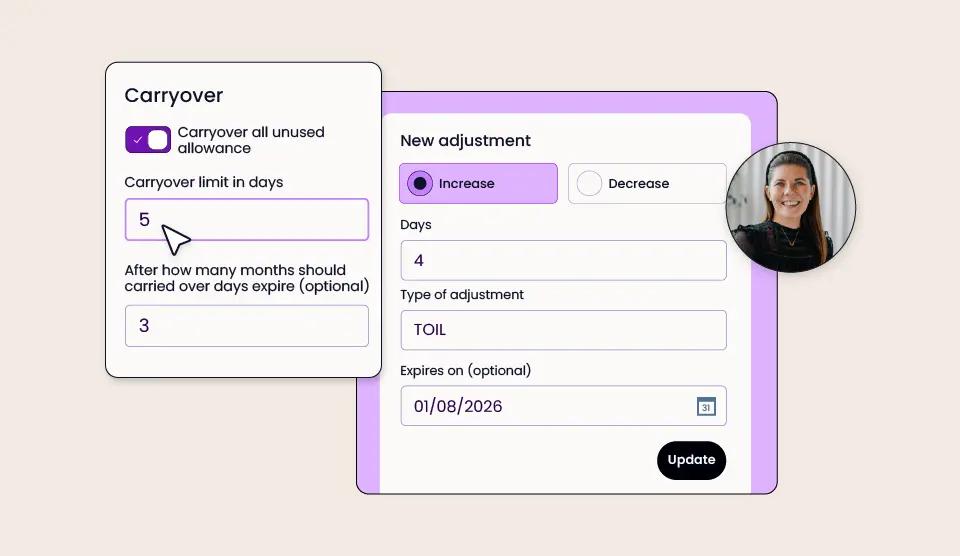
With a leave management system, this is largely automatic: carry-over is calculated and applied at year-end, team members can check their own balance without asking anyone, managers get full visibility over the whole team's time off, and you get a report flagging who's sitting on too much unused leave, or who keeps carrying leave over year after year, which is usually a sign they need a nudge, not a policy change.
This is what Charlie does, so if you want to check it out, you can take a free trial below. If you'd rather compare providers first, here's our roundup of the best leave management software for small teams.
No, under UK employment law, only leave taken above the statutory minimum of 28 days (inclusive of bank holidays) can be carried over. Businesses offering exactly 28 days have no carry-over to allow.
No. The law sets a ceiling on how much can be carried over, but whether you allow any rollover at all, and under what conditions, is entirely up to you as the employer.
Statutory sick pay and family leave allowances reset annually and don't carry over in the same way holiday does. However, if long-term sickness or parental leave stopped someone taking their holiday, most employers choose to let that holiday carry over as an exception, this is worth writing into your policy explicitly.
Without a written policy, unused holiday is typically lost at the end of the leave year (beyond any statutory carry-over rights), which is exactly the kind of ambiguity that leads to last-minute disputes, best avoided by setting the rule in advance.
Check your team's carry-over report for four things, and act on each differently. First, flag anyone who rolls over holiday every single year, that's usually a sign they need a prompt to book more leave throughout the year, not a policy change.
Second, check anyone whose remaining holiday already exceeds your carry-over limit, and prompt them to use it before the deadline. Then, review anyone who's used more than their allowance.
With Charlie, for example, it won't automatically deduct days from next year's entitlement, so you'll need to check this manually against your own policy.
Finally, if a large share of your team always has more leftover holiday than your policy allows, treat that as a signal your allowance itself may be too generous or too restrictive, rather than a problem with individual employees.