Automate all your repetitive HR tasks and save yourself hours every week to focus on your most important work.
Book a demoIf you’re not sure what the difference is between onboarding and induction, you won’t be the first person and you won’t be the last.
Employee onboarding is often mistaken for an induction day – the welcome email, the ice-breakers, a flashy Google Slides deck walking new hires through the company values. It’s none of those things, really. Or rather, it’s all of them and much more. It’s the very beginning of the employee journey.
From my experience, employee onboarding is the foundation your new hire builds their first impression of your business on. And for small businesses, that foundation is shakier than most. The person running onboarding is rarely an HR professional – they’re a founder, an office manager, or a line manager learning on the job, doing this alongside their other full-time role.
That’s why the stakes are higher when small businesses get this wrong, and why best onboarding practices must be followed. The laptop doesn’t arrive on day one. The contract hasn’t been signed. Compliance gets left to the last minute. And by the end of week one, your new starter is already quietly weighing up whether they made the right move.
There’s plenty to get wrong. But there’s plenty you can get right – with the right guidance.
Small businesses have every right to succeed against bigger, more established competitors – but only when they can ease the friction that comes with small teams juggling multiple hats.
“You can get so bogged down in admin, and if you’ve got all that admin living in a hundred different places which don’t talk to each other, then you just end up spending hours clicking through files. And that wasted time is time you could be spending on more exciting projects.”
Caitlin Price, Office Manager at Bloom & Wild
Effective onboarding for small businesses is more than the short-term task of welcoming new hires on board.
It’s about your long-term retention and time to productivity. It’s about convincing your new hire easily that they made the right decision to join your small team. If you’re not invested in this, your new hires won’t be invested in their future with you.
This is critical at a time when employee engagement is at its lowest since 2020. In the UK, only around one in ten employees are engaged (lower than the European average), which gives you all the more reason to get your onboarding ducks in a row.
Within the first days of meeting your team, they must be able to visualise a good future at your business, and it’s your job to give them that during onboarding.
You’ve got to remember that the new hires you bring in – especially the more senior ones – have been through plenty of onboarding processes before and can tell a rushed one from a thought-through one.
As a founder or office manager without the HR headcount to lean on, you need to feel confident in your onboarding process every single time. You’ve spent weeks recruiting, interviewing and chasing references to bring the right person onto your small team. They deserve an onboarding experience that matches that effort – and you deserve the peace of mind of knowing it’s handled.
I’ve seen a lot of companies that are happy to wing their onboarding, but I can tell you that the best small businesses always treat onboarding as a well-designed journey, not a dry formality.
“Effective” at this scale doesn’t mean piling on your workload by devising enterprise-level L&D programmes or 50 Google Slides on mission, vision, values. It means that you are consistent, compliant, human and fun every time you welcome someone to your small team, without you having to rebuild it from scratch.
If you’re hiring for the first time, these four onboarding steps should form the foundation of your initial process – it’s nothing flashy, but it breaks down:
Our employee onboarding checklist gives you everything you need to implement these steps.
✅ Goal: To set your new starter up for success before day one.
Everything that happens between the offer being accepted and day one falls into pre-boarding – that means compliance checks, contracts, equipment, welcome communication.
The right to work checks, HMRC starter checklist and UK-compliant data protection (GDPR) briefing must be completed at this onboarding step before your new starter turns up on day one with problems that reflect poorly on you.
This step is also where you make your first impression as an employer. Done well, your new hire shows up feeling expected and equipped. Done badly, they arrive to someone telling them their laptop hasn’t been delivered and a contract they signed at 9am on day one.
💡 Common mistake: Avoid treating compliance as an afterthought. It looks bad from the get-go.
✅ Goal: To make your new starter feel expected, welcome and ready to go.
The hiring manager and line manager need to be across the plan, laptops, logins and extra equipment need to work, and nothing should be left to chance or improvisation. You’re validating why your small business is the perfect environment for the new hire to succeed.
This is also where the human element matters most – the welcome call, the team introductions and the sense that you’ve been expecting them. These go a long way and should absolutely be covered on their first day.
💡 Common mistake: Don’t wait until your new hire‘s first morning to start onboarding – it should begin once they’ve signed their contract. Also, don’t leave the new hire to introduce themselves to everyone.
✅ Goal: To give your new starter early clarity and early wins.
Week one is where orientation starts turning into contribution.
Your new hire is absorbing the ins and outs of their role, the team, the business context – and forming their first real opinion about whether they’ve made the right professional move long-term.
Clear goals, regular check-ins, a buddy to lean on and introductions with key stakeholders all matter here. This is also where onboarding often falls onto the line manager by default, with no structure behind them – which is where most problems start.
💡 Common mistake: Avoid leaving the new starter’s experience entirely to the line manager with no structure to support them – they are often doing this for the first time and need guidance.
✅ Goal: To move from orientation to integration and performance.
This is where onboarding transitions into ongoing management. Structured check-ins at 30, 60 and 90 days keep you honest and clear about how things are actually going – according to both your checklist and your gut. The outcome of the probation review should never come as a surprise.
After that probation conversation, most small businesses let their onboarding experience fade away – the employee onboarding checklist is technically “done”, but no one’s actively checking in. This isn’t ideal and can impact employee retention, but I’ll discuss more what should be continued in the next section.
💡 Common mistake: Avoid using a static checklist nobody tracks or owns, and don’t forget that onboarding continues long after week one. Teams use the CharlieHR onboarding checklist because they can assign tasks, track progress and reuse it for following new hires.
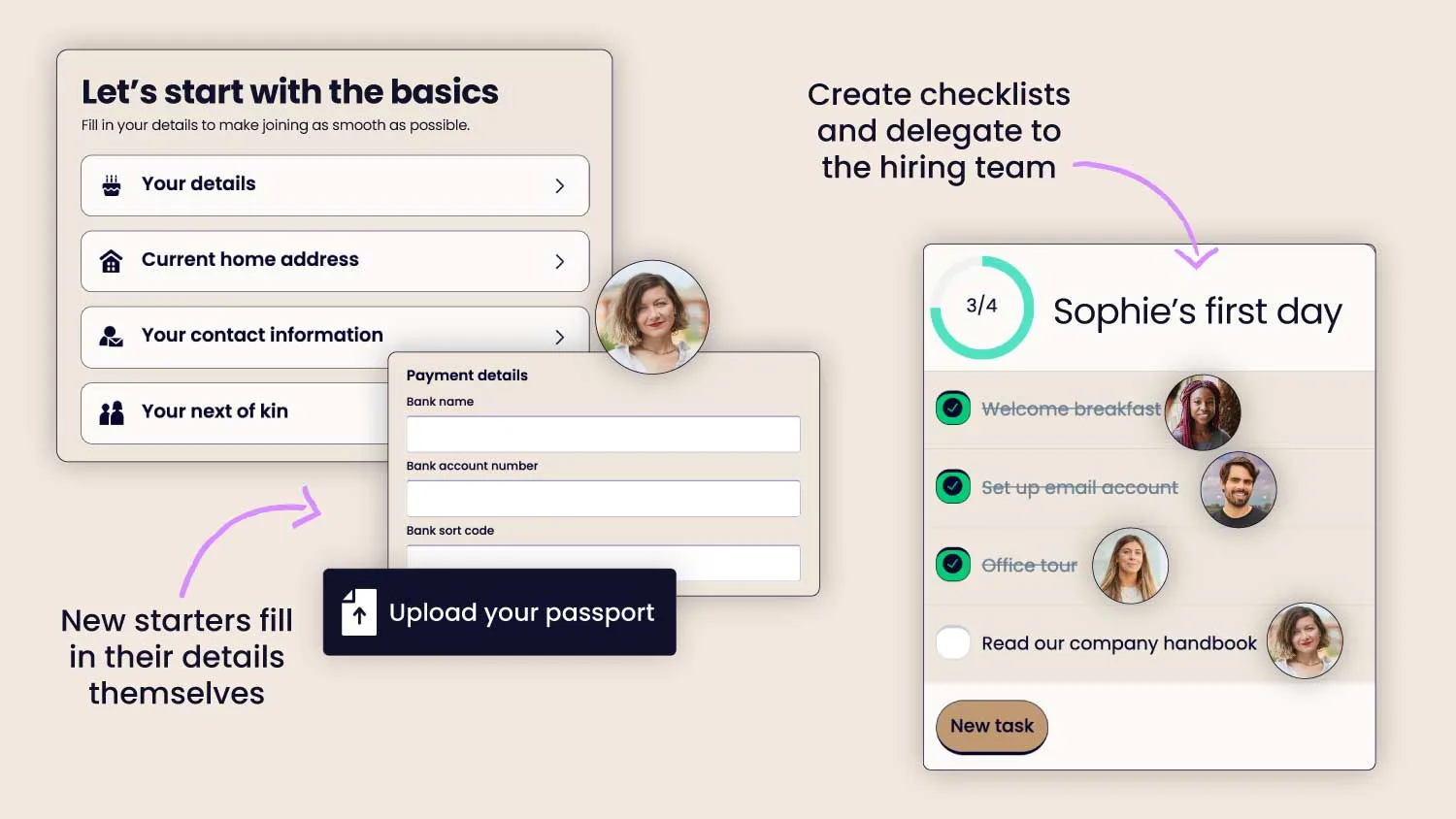
You might be wearing multiple hats, but your onboarding one doesn’t come off on day 90. The best small businesses see onboarding as a process without a definitive end date – not a checklist to just tick off. We know how important continuous feedback, check-ins and small adjustments are to not only keep new hires engaged, but to also help improve company processes.
New hires are the only people who can tell you what your onboarding process actually feels like, and their insights will be sharpest in the first few months, so grab those insights before they fade away.
If your team continues to welcome new starters, one of the first things to look at is the quality of the onboarding experience. Where can things be smoother, more consistent, better, more automated – or alternatively more human? It’s really worth considering at this stage whether you should move beyond your static checklist.
It might have been a good place to start, but static Google or Word docs and spreadsheets go out of date. They get duplicated multiple times, forgotten or buried in shared folders or drives. Compliance items might get neglected without automated reminders. Shifting from a document you maintain manually to a process that runs itself is usually where small businesses find the time and consistency – and onboarding improvements – they’ve been missing.
Everything in this guide is, of course, possible without software. You can run onboarding on a spreadsheet, a shared Google Doc, do onboarding with Notion or run your process with Trello and a series of calendar pings – plenty of small businesses do this, and plenty do it well enough for their first few hires.
But you need to ask yourself whether you can keep managing that manually as your team grows and your own workload increases. Your new hires tend to start feeling these gaps.
“Charlie took all of that (onboarding) nonsense away. New team members can go through the onboarding steps themselves and I can track how much progress they made to completion. I feel everything is under control and it’s virtually impossible to forget anything.”
James Gill, CEO at GoSquared
When you add new hires – and even new managers – to your team, you need a reliable process in place. Specialised employee onboarding software like Charlie is built for small businesses without a dedicated HR team. It handles all the onboarding steps above and crucially leaves your small team the time to really welcome the employee as a new colleague. And it does this time and again, for every new hire – it scales with you.
Induction is a single event – normally a day or a morning spent introducing a new hire to the company, the team and the basics of the role. Onboarding is the longer process that surrounds it. Induction might be your new hire’s first day; onboarding is everything from the offer letter being signed through to their 90-day review.
The 5 C’s of onboarding are a framework some companies use to structure their onboarding process: compliance, clarification, culture, connection and confidence (sometimes called check-ins). It’s a useful framework for thinking about best onboarding practices.
Most onboarding processes break down into four steps or stages: pre-boarding (everything that happens before day one), day one (introductions, IT setup, compliance briefings), week one (role clarity, daily check-ins, training) and the 30/60/90-day reviews (settling in, feedback, probation).
The person responsible for HR in a small business is rarely a dedicated HR professional; it’s usually a founder, office manager or operations lead juggling it alongside their other responsibilities. Their role is to make sure the process runs end-to-end: contracts signed, compliance met, equipment shipped and a structured first few weeks in place. Good onboarding software can take most of the admin off their plate, so the human parts of the job get the attention they deserve.
The best onboarding processes start before day one, split ownership clearly between whoever’s involved (HR lead, line manager, IT), build in regular check-ins and are inherently welcoming for new hires. For a small business without an HR team, the simplest examples are often the most effective: a clear four-stage checklist, assigned owners and an automated tool to track progress rather than a static Word doc.
Formal employee onboarding typically runs to 90 days, ending with a probation review – but the most influential period is usually the first week. That’s really when new hires decide whether they’ve made the right move. The first 90 days are where structure, check-ins and clear feedback have the biggest impact. Beyond that, regular 1:1s and ongoing manager support become part of the everyday job, not just onboarding.
There are important legal requirements to consider when onboarding a new employee in the UK. Before or on day one, UK employers must complete a right to work check, issue a signed employment contract and issue an HMRC new starter checklist for payroll. Health and safety obligations – including a Display Screen Equipment (DSE) assessment for home workers – and GDPR and data protection training are also required. Compliance guidance changes occasionally, so it’s worth checking the latest rules on GOV.UK before each new hire.
To create an onboarding process from scratch, you should start with the four stages: pre-boarding, day one, week one and 30/60/90-day reviews. For each stage, list the tasks that need to happen, assign an owner and flag anything that’s time-sensitive or legally required. Keep it simple – once the basics are in place, you can refine as you go and discover what worked well with your last new hire, what felt rushed, what felt unclear.
Effective onboarding for small businesses comes down to a few things: clear ownership of tasks, early communication with the new hire, a structured day one, regular check-ins and the right tools to handle the admin. The goal isn’t to compare yourself to what enterprise businesses do – it’s to make your new hire feel welcomed, equipped and settled in the expectations of their new role.
Most small businesses start with a shared Google Doc, Notion or Trello ,with an onboarding checklist and some task owners – and for your first few hires, that’s fine. The problem is that spreadsheets go out of date fast, nobody owns individual tasks and things slip through without anyone noticing. Onboarding software for small businesses takes the admin chasing off your plate, gives you consistency across every new hire and scales as your team grows. You don’t need it on day one, but it’s much easier to put in place early than to adopt it later, once every new hire feels like a fresh scramble.