

Jump to a section on this page
Key takeaways
Why a short welcome message to new employees is important
What should a first-day welcome email include
Welcome email: 3 longform examples
Short welcome message: 15 examples
What’s the best way to send a first day welcome email?
FAQs

Key takeaways
- A well-timed, warm welcome email sets the tone for your new starter’s experience and reassures them they’ve made the right call.
- Your welcome email should strike a balance between practical information (start time, schedule, who to contact) and genuine warmth.
- The savviest small businesses build welcome emails into their repeatable onboarding workflows so they never get overlooked.
Welcoming new faces to your team is one of the most exciting milestones for a small business. New starters are a sign of healthy business vitals – and a reward after what’s often a careful, lengthy recruitment process to find the perfect person for your team.
But a day in the life of a small business founder – managing payroll, monitoring performance, staying on top of legal tasks – rarely leaves room for the small but critical people tasks. Like writing a welcome message for new employees. One that’s well-timed and written with warmth, and leaves a positive and professional first impression.
If you’re overlooking this task now, you wouldn’t be the only one. We know this short message is seen as a formality, but it does more than you think. It sets the tone for what your company is actually like to work at, gives your new starter the information they need to feel prepared on their first day and reassures them they made the right call to join your team.
A generic message sent the evening before – or nothing at all – creates doubt. And at a small business, where the relationship is personal from day one, that’s a red flag.
Your welcome message doesn’t need to hit a word count or be polished to perfection. I’ll tell you how (and when) to write a welcome message that feels genuine, with ready-made templates you can save into your workflows – and make welcoming new starters the exciting step it should always be.
Why a short welcome message to new employees is important
You’ve worked hard to build your small business, and you’ll want to welcome new employees that become just as invested in what you’ve built as you are – especially at a time when employee engagement in the UK has dropped to 10%. So welcoming them in a way that really fuels their enthusiasm from their first day is important.
Pre-first-day communication always lands well – no matter the seniority of the person you’re hiring. This is why sending a new employee welcome email benefits you as much as it benefits them. It’s one of the onboarding best practices we always recommend.
1. They’re a great way of keeping in touch
Notice periods can often be quite long, stretching from one to three months, especially if you’ve hired someone in a senior role. A short welcome email to your new employee will help you nurture a strong sense of connection right from the beginning.
2. They help you look professional
There’s nothing more confusing for a new hire than when the company that’s recruiting them goes off the radar. A short welcome email ensures this doesn’t happen, helps put them at ease and is an easy way to show you’re a professional business.
3. They get hires excited about their new job
While working out their notice, new hires can start to feel bored. It’s up to you to make them feel excited about their new role. A short welcome email can include info and updates about your business, introduce their new team and talk about the sort of projects they’ll be working on.
4. They help you share the right amount of information
No one wants to walk into a new job without any idea of what they’ll be doing, but they also don’t want to feel overwhelmed by too much information. A short welcome email will help you strike the right balance.
5. They already feel part of the team
The clue is in the name: these are emails designed to make people feel welcome. You can decide how much team info is the right amount – for example, you might share everyone’s LinkedIn profile or link to a company directory like the one we have at Charlie.
A short new employee welcome email makes first days and introductions much easier, and provides context around your team and your business. It really doesn’t take much to feel part of a team, but it will make all the difference to the person coming on board.
What should a first-day welcome email to new employees include?
Welcoming new employees is really important to us at Charlie, so we like to send a fairly detailed welcome message to our new starters. As we’re a hybrid working company, it’s also likely we won’t see them in person on their first day – our welcome message is one of the ways we ensure we’re still proactive about building a personal relationship with them.
And this starts from the moment they accept your offer. Depending on how long your new hire’s notice period is, I would aim to send the welcome message a week or so before their start date.
Here’s what we include in our welcome email to new employees:
- The time and date they’re meant to start (as a reminder)
- The place you’re going to meet them (if you are)
- Their schedule for the first day
- Any extra information they need such as what to bring (laptops etc.)
- An opportunity to ask you any questions
- How your business is organised
- An onboarding plan
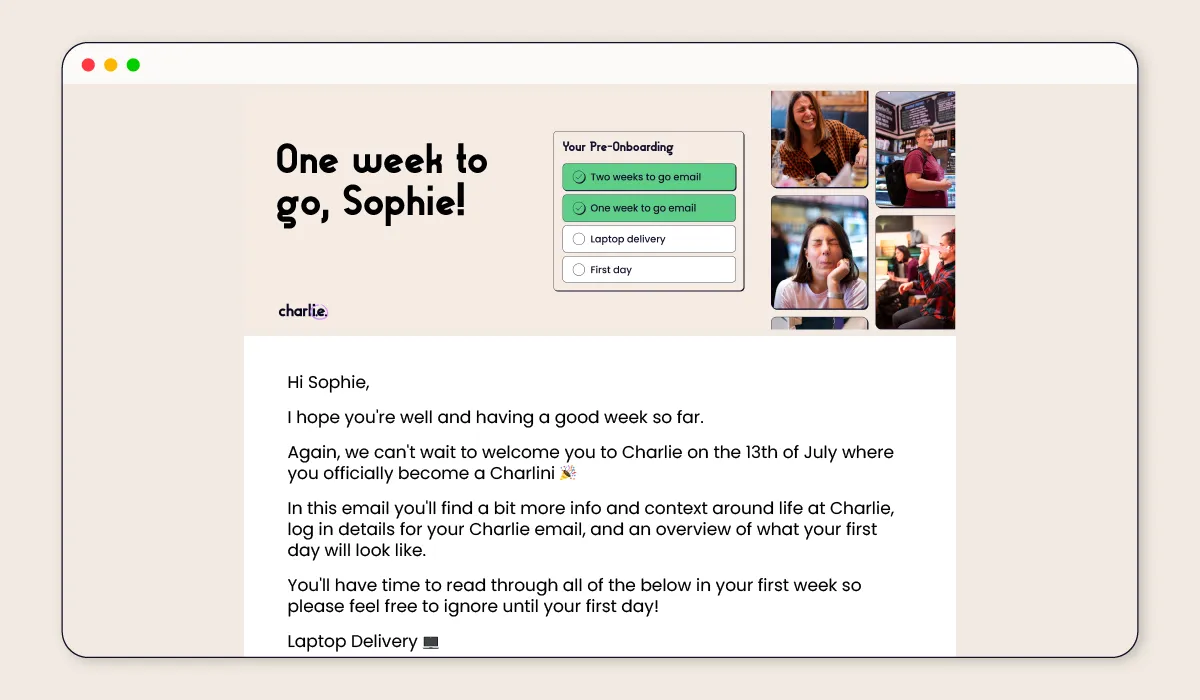
The message and the logistics are both part of this welcome message – whether you want to write a short or long email to your new starter. Because your warm message will always be undermined if the new starter arrives and nothing is ready for them. This is where having a clear set of onboarding steps for the pre-boarding stage makes all the difference when it comes to the right preparation.
Let’s look at two of these bullet points more closely so you can better understand what I mean.
How your business is organised
We work flexibly at Charlie, so we mention this in our short welcome email to new employees. It really helps us set clear expectations.
We mention that we’re a hybrid team, so we communicate in our new employee welcome email the days people tend to be in the office and which days people work from home. You might want to cover things like your core working hours, whether your team uses flexitime, if there’s a regular all-hands meeting they should know about, or how communication works (e.g. Slack for day-to-day, email for external).
It will depend on your business of course, but an onboarding welcome email to a new employee is a great place to introduce them to how you run your business, so they can visualise their new working day from the outset.
An onboarding plan (even a rough one)
Including a bit about onboarding in the first-day welcome email is always a good idea. Again, this is about managing expectations and putting your new employee at ease.
This doesn’t need to be a full schedule. Even a line or two helps: letting them know they’ll have a welcome call or meeting with their manager on day one, that their first week will focus on getting set up and meeting the team or that they’ll have a 30-day check-in to see how they’re settling in.
Starting a new role at a small business of under 50 employees can be intimidating, so having an idea of what to expect is typically really appreciated.
Your welcome email to new employees: 3 longform examples
A longer welcome email works best when there’s practical detail your new starter needs before day one, like where to be, who they’ll meet and what to expect.
And although you might automatically think “longer” means you have to spend longer on these emails, we’ve got some pre-approved templates for new starter welcome emails you can use.
Example 1 – Welcome email to new hybrid-working employees
This is to give you an idea of how we welcome new hybrid team members at Charlie. Feel free to copy it and tweak as you please.
Hey [name],
I hope you’re well and looking forward to next week – we’re very excited to have you start!
I just wanted to drop you some info about your first day so you know what to expect. I’ve also cc’d in some relevant people so you have their names and email addresses.
Your buddy will be [insert name]; they’ll book in some time with you in your first week and are on hand for any questions, anytime.
As we have very flexible working hours, people start at different times of the day, but everyone always joins for our 10am all-hands meeting each morning.
I’ve put in a Google Calendar invite (with Google Meet link attached) for [time, date] for half an hour, then we’ll rejoin Huddle together at 10, which is also in your calendar [adjust as necessary].
You'll spend most of your first day with [insert name]. You should already have your Charlie laptop, but I’ll help you set it up and start working through some more onboarding bits.
Overall, we’ll take it pretty easy and give you plenty of time to read things and ask lots of questions.
Reach out to me on Slack any time as if we were in the office – treat me like I’m sitting next to you! And you’re welcome to join in conversations and ask questions on any public Slack channels or DM anyone you like.
See you on [date]!
[your name]
Example 2 – Welcome email to new employees based in an office
This is a great welcome email to send ahead of a new member’s first day in the office.
Hey [name],
Welcome to [name of the company]. We’re excited to have you on board! This is just a short email to let you know what’s going to happen when you start on [start date].
I thought we could spend the first day in the office together, so I’ll wait for you in front of the entrance at [address for your office] at 9am.
We can grab a coffee and set up your laptop, and I’ll run through a few of our policies and processes. Then you’ll meet the team!
Please let me know if you need anything in the meantime. I’m really looking forward to working with you.
Best,[your name]
Example 3 – Welcome email to new employees who work remotely
Remote onboarding requires a different approach, and it’s important that your new hires feel as much part of the company as anyone else. Here’s a good example of how to welcome them.
Hey [name],
Welcome to [name of the company]! It’s great to have you on board and I’m looking forward to seeing you on [start date].
Since we all work from home, I want to make sure you don’t feel isolated on your first (or any!) day, so I’ve scheduled a few meetings – including a coffee catch-up to start the day.
Once we’ve chatted a bit, I’ll run through some admin and then will slowly start to introduce you to our work and processes. Hope that sounds okay!
Your laptop will be delivered in the next few weeks. I’ll either be in touch regarding delivery or you’ll receive a text message.
In the meantime, please just shout if you have any questions. Here for anything you need!
Best, [your name]
How to write a short welcome message to new employees: 15 examples
Not every welcome needs that level of detail. So when would you write a short welcome message for your new hires?
Either you as the founder or the new hire’s line manager can send a short welcome message as a company-wide memo or directly to your new employee. The benefit of sending it to everyone is that you announce their arrival and introduce them at the same time. They feel appreciated from the first day, and they get a sense of how excited your team is to have them on board.
The following examples of warm and engaging new starter welcome emails are great for sending over email or via a messaging platform like Slack.
Short welcome message for new employees – a warm welcome
- Welcome to the team, [name]! We’re sure you’ll fit right in and good luck for your first day. Some of your new team will be in touch to introduce themselves over a coffee – please just shout if you need anything.
- Welcome! We’re so pleased to have you on board and are looking forward to working with you.
- A warm welcome to our newest member of the team, [name]! Today’s their first day so please introduce yourselves :) [Name], this is our team chat channel – it’s super informal and a great place to get to know everyone. Feel free to ask any questions and chat with the team!
- Welcome to the [company] team! Congratulations on the new role – it’s great to have you with us. First days are always a bit of a whirlwind, but we hope to make it as stress-free as possible. Here for anything you need :)
- We’re excited you’re joining us and would like to extend a really warm welcome to our team.
Short welcome message for new employees – a supportive welcome
- Great to have you here, [name]! We can’t think of a better person for the job, and I’m sure you’ll get up to speed in no time. Looking forward to achieving great things together!
- Welcome, [name]! We are so excited to have you as a part of the team and are here to support you in all the ways we can. You’re going to do great things here!
- Congratulations on the new role! We’re excited for everything you’re going to achieve and are here to help you get there.
- Welcome to [company name], [name]! I’ve booked some time in your calendar so that you can meet the rest of the team, but please don’t hesitate if you have any questions before then. We’re all here to help you find your feet as quickly as possible!
- Hi [name]! I wanted to introduce myself and let you know how excited I am that you’ve joined the team! We’ll be working closely together on several projects and I can’t wait to hear your thoughts and ideas. If you fancy an intro chat over a coffee, then just pop a meeting in my calendar. Have a fantastic first day and welcome to [company name]!
Short welcome message for new employees – focus on growth and collaboration
- Welcome, [name]! This is such an exciting time to join [company name] as we’re in a period of real growth. It’s going to be busy, challenging and very rewarding! We’re looking forward to you being a part of it.
- Good to have you here, [name]! We’re excited that you’ll be helping us build a more creative and collaborative space. Don’t hesitate to bring ideas to the table or share any feedback. We’re delighted to have you on the team!
- Congratulations on joining the team! We work closely and collaboratively and know you’re going to fit right in.
- Welcome to [company name]! Looking forward to working with you and achieving great things together.
- Welcome, [name]! Grab a coffee and take a moment to settle in. We’ve got a team meeting at [time] so you can meet everyone you’ll be working most closely with. And I’m here for any questions whenever you need. Great to have you with us!
This last group works particularly well when welcoming someone in a more senior role.
What’s the best way to send a first-day welcome email?
Now you’ve got a good idea of what to include in a short welcome email to new employees, you’ve got to decide on the best way to send it.
The savviest small businesses incorporate the welcome emails as part of their set onboarding checklist. This way, they don’t overlook it; they don’t overthink it; they don’t risk any negative first impressions from confused or neglected new hires. The easiest way for small businesses to maximise their onboarding efficiency without draining energy from other business activities is through automated onboarding workflows – and not from the tenth or twentieth or thirtieth employee, but from as early on as possible.
Charlie HR’s software lets you auto-generate or customise a short welcome message to new employees, which is sent directly to your new starter as part of their onboarding flow.
It’s one of the best practices for writing a new starter welcome email: keep it personal, but let a platform for automating new employee onboarding communication handle the timing and delivery.
This automated workflow simplifies onboarding for small businesses by making it repeatable but still personal. This means business owners leave a positive impression without leaving their numerous everyday tasks behind in a backlog.
Easily onboard your team members today
Book a demoThis software is designed to save you time and make every aspect of onboarding seamless, easy and compliant with UK employment laws. You create a new team member’s profile and Charlie does the rest:
- Your team is aware on the new hire’s first day via a Slack integration, so no one can miss it
- Charlie’s home page features an announcement alongside the new starter’s name and photo
- Your new employee has instant access to their onboarding flow and all the information they need in one place, including who their new team members are, from day one
- Your new hire can upload any documentation securely and complete their own HR admin (including the new starter checklist, which they fill out directly in the software)
- They also have easy access to your company policies and any other important documents, as these are all stored centrally in Charlie
Rachel Carrell, Founder & CEO of Koru Kids
“We were a very small and scrappy startup before using Charlie, and the software has put us in such a stronger place to hire and grow.”

The software ensures that new hires start, settle and feel supported from before their start date to reassure them they’ve made the right decision to move jobs.
FAQs
How do you write a welcome message to a new employee?

Knowing how to professionally say welcome to a new employee is daunting. But a professional welcome doesn’t mean a stiff one – especially if you’re a small business. “We’re really looking forward to having you on the team, [name]” is both professional and warm. At a small business, your natural voice is your biggest advantage. You can find professional new starter welcome email templates on this page for guidance.
How do you create an effective new starter welcome email?
Knowing how to create an effective new starter welcome email is key before you weave it into your repeatable onboarding process. Include the practical details they need before day one: their start date and time, where to go (or how to join remotely), who they’ll meet, and what to expect.
What should you avoid including in a welcome email?
You should avoid mentioning salary, benefits and contract details in your welcome email to new employees. Those belong in formal HR documentation, not in a message that’s meant to make someone feel excited about joining. Avoid overwhelming them with task lists, project briefs or deep dives into who’s working on what.
How long should a welcome email to a new employee be?
There’s no fixed rule, but shorter is almost always better. A good new starter email covers the essentials (when, where, who, what to expect) in a way that’s easy to scan. If your new starter needs more detail, like a first-day schedule or onboarding plan, a longer email is fine, but keep the tone conversational and break up the information so it doesn’t feel overwhelming. The templates in this guide range from two sentences to a full page, depending on how much practical detail you need to include.
When should you send a welcome email to new employees?
Send a welcome email a week or so before your new employee’s start date covering the essentials (when, where, who, what to expect), and consider a short team-facing announcement on Slack or email so the rest of the team knows to say hello. This gives your new starter time to read the details, ask any questions and feel prepared, without it landing so early that it gets buried in their inbox. Sending it the night before (or worse, not at all) is the most common mistake. If there’s a long notice period, a short check-in message a few weeks before they start can also help maintain the connection and keep them excited about joining.
Who should send the welcome email: the founder, the line manager or HR?
At a small business, you probably don’t have a dedicated HR person, and that’s fine. The most important thing is that the email comes from someone the new starter will actually work with. For very early hires, that’s usually the founder. As the team grows, it often makes more sense for the line manager to send it, since they’ll have the most direct relationship. Whoever sends it, the tone should feel personal rather than automated.
What’s the difference between a welcome email and a new starter announcement?
A welcome email and a new starter announcement serve different purposes and go to different people. The welcome email goes directly to your new starter before their first day. It’s practical and personal: start time, schedule, who to contact, what to expect. The new starter announcement goes to your existing team, usually on or around the start date, introducing the new hire and encouraging people to say hello. Both matter – your new starter needs reassurance and information. Your team just needs a nudge to make them feel welcome.
Are there platforms for automating new employee onboarding communication?
Platforms for automating new employee onboarding communication help small business owners keep on top of tasks when they’re hiring for their team. Onboarding platforms like Charlie let you automate the timing and delivery of welcome emails as part of a broader onboarding workflow, so your new starter gets the right message at the right time without you having to send it manually. You set it up once, customise the message to sound like you and it runs every time you bring someone new on board your small team. That means you can focus on the personal side of welcoming someone rather than the logistics.
CharlieHR
ProductCharlie GrowCharlie RecruitPricingCharlie for CEOs, founders and MDsCharlie's boardroom