Automate all your repetitive HR tasks and save yourself hours every week to focus on your most important work.
Book a demoEvery UK employer needs a written grievance procedure, whatever its size. But most small businesses only think about theirs the day someone hands them a formal complaint.
There was this time where one of our clients got in touch because the wording on the working abroad policy left some room for doubt. An employee went over the allowance and got a written warning. Problem? They went back to the wording, said it was unclear and raised a grievance. It all could have been avoided with the right wording.
Even more of a problem? The business didn't have a written grievance policy and had to start from scratch. The HR advice team, which I'm part of, was here to help, but it was a stressful time for the business. Something you don't want to see happening at your own company.
In this guide, I'll explain what a grievance policy and grievance procedure are, what UK law actually requires, and the five steps to follow when a grievance lands on your desk. I'll also share Charlie's grievance policy template, which you can copy and use today.
A grievance policy is a written document that tells employees how to raise a formal complaint at work, who to raise it with, and what will happen next.
Grievances can range from a clash with a colleague or manager to a dispute about pay, hours or contract terms. If an employee tries to resolve a problem informally but isn't satisfied with the outcome, they can make a formal grievance in writing.
Your grievance policy makes sure every complaint is handled with fairness, transparent and consistency so your team knows it will be taken seriously.
A grievance procedure is the step-by-step process your grievance policy sets out: how a grievance is raised, investigated, decided and appealed. In short, the policy is the document and the procedure is what you actually do.
If someone feels that a problem at work cannot be settled informally (or doesn’t want it to be), they can raise a grievance. In raising a grievance, they set the grievance procedure in motion.
The grievance procedure has a structure that both the employer and the employee must follow — and is typically used when attempts at informal resolution have failed, or for problems that are serious in nature.
Yes. Every UK employer, even small businesses, must tell employees in writing who to raise a grievance with and how to do it. This goes in the written statement of employment particulars every employee gets from day one, or in a document they can easily access, like your employee handbook.
Three other rules matter:
As a small business, you'll have a much harder time recovering from a tribunal reward, especially if you don't have the cash for it. And from 1 January 2027, anyone with six months' service can bring a claim, and there's no longer a cap on what a tribunal can award. That's where it's crucial for you to have the right policies in place.
If you include your grievance procedure in employment contracts and then don't follow it, an employee can also claim breach of contract. Most businesses keep it in the handbook for that reason.
A UK grievance procedure has five steps: the employee raises the grievance in writing, you hold a meeting, you investigate, you give a written decision, and the employee can appeal. Before any of that, it's worth trying to sort things out informally.
The employee should first try to raise the issue informally, with the person involved or their line manager. Many problems are solved here, and it's quicker and less stressful for everyone.
The employee can skip straight to a formal grievance if informal resolution hasn't worked, if they don't want to deal with it informally, or if it's a serious issue such as sexual harassment or whistleblowing.
The employee sends a written grievance setting out the complaint and anything they've already tried. Your policy should say who to send it to, and who to go to instead if that person is involved. If you need to help someone put it into words, point them to our grievance letter template.
Acknowledge it in writing within a couple of days, and tell them what happens next and roughly when.
Arrange a meeting without unreasonable delay. That's the Acas wording; at Charlie we recommend within five working days so nothing gets missed. Tell the employee they can bring a colleague or trade union representative.
In the meeting, the employee explains their grievance and how they'd like it resolved. Your job is to listen carefully, ask questions, and take detailed notes. Afterwards, share the notes, ask the employee to confirm they're accurate, and tell them when to expect a decision.
If needed, gather evidence, talk to everyone involved, and hold a follow-up meeting if new information comes to light. If you can, ask someone who isn't involved in the complaint to investigate. In a small team, that may mean bringing someone external, especially if you don't have an HR person on board. For help with what to ask, see our guide to investigation meeting questions.
Make a decision based on what you've found and write to the employee with your findings and your reasoning. A grievance can be upheld, partly upheld, or not upheld. If you uphold it, say what action you'll take.
If the employee disagrees with your decision, they have the right to appeal. Tell them how to do this in your decision letter. Where possible, the appeal should be heard by a more senior manager who wasn't involved in the original decision.
You can suggest mediation at any stage. A mediator is an independent person who helps both sides agree a solution. It doesn't replace the formal procedure, but it often stops a grievance escalating. I'm a qualified workplace mediator myself, and it's a skill I can bring to your business should you ever need it. For more information on what that could look like, Charlie Grow is here to help.
There's no legal deadline for each stage of a grievance. The Acas Code only says employers must act "without unreasonable delay". That's why your policy should set its own timescales.
Here's what we recommend at Charlie:
There might be an investigation needed, and that might take longer. If that's the case, just tell the employee and give them a new date. Although there are time limits for when a grievance can turn into a tribunal claim, that's about to change in the new year. Going forward, tribunal claims for unfair dismissal can open after 6 months.
At minimum, your grievance policy must say who employees should raise a grievance with and how. A good policy also covers:
Handling a grievance in a small business is stressful. In a small team you're often navigating personal relationships as well as professional ones, so things can feel especially delicate.
We're a small business too, so we get it. What works for a big company doesn't always work for a team of ten.
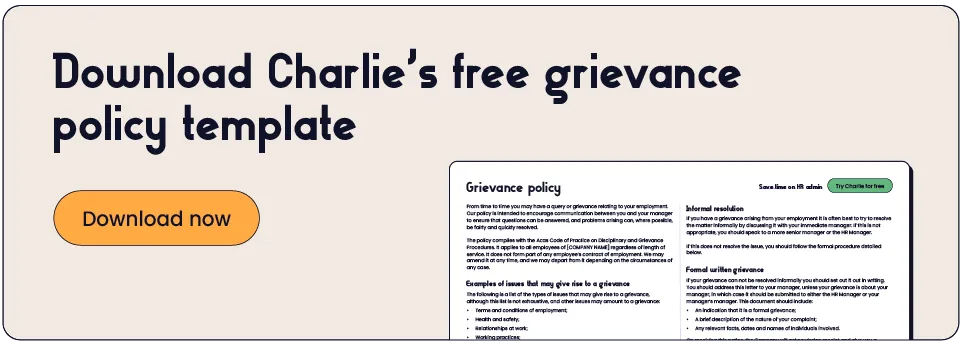
That's why I'm sharing Charlie's own grievance policy below. Copy it as it is, or adapt it to fit your team.
From time to time you may have a query or grievance relating to your employment. Our policy is intended to encourage communication between you and your manager to ensure that questions can be answered, and problems arising can, where possible, be fairly and quickly resolved.
The policy complies with the Acas Code of Practice on Disciplinary and Grievance Procedures. It applies to all employees of [COMPANY NAME] regardless of length of service. It does not form part of any employee's contract of employment. We may amend it at any time, and we may depart from it depending on the circumstances of any case.
The following is a list of the types of issues that may give rise to a grievance, although this list is not exhaustive, and other issues may amount to a grievance:
This grievance procedure should not be used to complain about dismissal or disciplinary action, or if your performance is being managed through the formal capability procedure. In this event you should submit an appeal under the appropriate procedure. If you feel you have either witnessed or been the victim of bullying or harassment, please refer to our Bullying and Harassment policy for further guidance and information.
If you have a grievance arising from your employment it is often best to try to resolve the matter informally by discussing it with your immediate manager. If this is not appropriate, you should speak to a more senior manager or the HR Manager.
If this does not resolve the issue, you should follow the formal procedure detailed below.
If your grievance can not be resolved informally you should set it out in writing. You should address this letter to your manager, unless your grievance is about your manager, in which case it should be submitted to either the HR Manager or your manager's manager. This document should include:
On receiving this notice, the Company will acknowledge receipt and give you a realistic timeframe within which a response will be forthcoming.
In some situations we may ask you to provide us with formal information before we can progress the matter.
Written grievances will be placed on your personnel file, along with a record of any decisions taken and any notes or other documentation compiled during the grievance process. These will be processed in accordance with our Data Protection policy.
It may be necessary for us to carry out an investigation into your grievance. This may involve interviewing and taking statements from you and any witnesses, and/or reviewing any relevant documentation.
You must cooperate fully and promptly in any investigation. We may ask you for names of witnesses for example, or to disclose any documentation to us.
When investigating a matter, the Company will bear in mind any concerns to raise relating to confidentiality, but you should be aware that a full investigation may not be possible without certain disclosures being made, and that, without a full investigation, it may not be possible or appropriate for the Company to reach the decision on your grievance that you wish for.
If any evidence is gathered in the course of the investigation, you will be given a copy in advance of the hearing. However, in exceptional circumstances such evidence given by individuals may have to remain anonymous and/or confidential - in this eventuality you will be given an appropriate summary of the evidence.
We may initiate an investigation before holding a grievance meeting, but on other occasions we may hold a grievance meeting before deciding what investigation (if any) to carry out. In those cases we will hold a further grievance meeting with you after our investigation and before we reach a decision.
We will arrange a grievance meeting, normally within one week of receiving your written grievance or of completing any necessary preliminary investigation.
You will be notified of the date, time and location of the meeting (which should be reasonable for you and the Company). You should make every effort to attend grievance meetings.
If you are unable to attend a meeting at the specified time please let us know immediately, and we will try, within reason, to agree an alternative time.
You may bring a companion (either trade union representative or a work colleague) to any grievance meeting or appeal meeting under this procedure. Please tell us who your chosen companion is, in good time before the meeting. If your chosen companion is unavailable at the time a meeting is scheduled and will not be available for more than five working days afterwards, we may ask you to choose someone else. If the Company does not consider your choice of companion to be a reasonable one, we may require you to choose an alternative. Your companion will be allowed reasonable paid time off to act as your companion. He/she is under no obligation to agree to be your companion.
If you have any difficulty with the grievance meeting, or at any other stage of the procedure, because of a disability or because English is not your first language, please let us know so that we can try to help you. We may for example invite you to bring a friend or a member of your family to the meeting, if this may help.
During the meeting your grievance will be discussed, and both parties will have an opportunity to explain their views. A third party may also be present to keep a note of proceedings. You should take the opportunity to explain your grievance, and how you believe it should be resolved. Any evidence will be taken into full consideration. If you choose to be accompanied, your companion may address the meeting and you will be allowed to confer privately with each other, but he/she will not be allowed to answer questions on your behalf.
If in the course of the meeting we feel that further investigation is merited, we will consider adjourning the meeting, and then reconvening it at a later date, once the necessary investigations have been carried out.
We will write to you, usually within one week of the final grievance meeting, to inform you of the outcome and of any further action that we intend to take to resolve the grievance, if applicable. We will also set out your right of appeal.
If you wish, you may appeal against the Company's decision. You should direct your appeal to the [COMPANY NAME] within one week of the date on which the decision was sent or given to you.
When appealing you should set out in writing which aspects of the decision you are challenging and why.
We will hold an appeal meeting, usually within one week of receiving your written appeal, unless you have raised further matters or evidence which require investigation. This will be dealt with impartially, and the appeal meeting will be held, if possible, by a more senior manager who has not previously been involved in the case (although they may ask anyone previously involved to be present). You have the right to be accompanied by a companion, as set out above.
We will confirm our final decision in writing, usually within one week of the appeal hearing, unless any subsequent investigation has been necessary. Where appropriate we may hold a meeting to give you this information in person. This is the final stage of the grievance procedure, and there is no further right of appeal.
These are the questions I get asked most when advising small businesses on grievances.
They should raise it with someone else, for example their manager's manager or whoever looks after HR. Your grievance policy should name an alternative contact for these situations. In a very small business, where the founder is the only senior person, consider an external HR person.
The person hearing the grievance, the employee raising it, and their companion if they bring one. If possible, include someone to take notes who isn't involved in the complaint.
No. An employee shouldn't be treated unfairly for raising a grievance in good faith. Dismissing or punishing someone because they complained about discrimination, whistleblowing or their statutory rights can be automatically unfair or count as victimisation. A grievance that's deliberately false or malicious can be treated as a disciplinary matter, but that's rare.
Grievances are often not upheld, or only partly upheld, because the evidence is unclear. It's often one person's word against another's, or the issue was a misunderstanding rather than a breach. A grievance that's not upheld can still lead to a change in HR procedures and policies.
There's no legal definition, but HR teams usually group grievances into three types: individual grievances (one employee's complaint), collective grievances (raised by a group or a trade union), and policy grievances (about how a workplace policy is applied).
Under the Acas Code, you can pause the disciplinary process to deal with the grievance. If the two are related, you can handle them at the same time. Your policy should say which you'll do.
Yes. We've shared Charlie's own grievance policy above, which you can copy and adapt for free.
You can also read about bullying and harassment policy, diversity and inclusion policy, equal opportunities policy.