Best for UK small businesses, including teams with under 10 people.
Last updated: May 2026
HR Information Systems (HRIS) help you automate tasks and save time across all your HR operations, but there are some that are better suited for small businesses than others.
In this guide, we’ll explore the best HRIS systems for UK small businesses — including their features, strengths, weaknesses, and pricing. We’ll also share a guide on how to choose the right HRIS for you, and the common pitfalls to avoid along the way.

Best for UK small businesses, including teams with under 10 people.
Best for AI-powered HR, finance, and payroll.
Best for midsized businesses with in-house HR teams.
Best for UK SMEs that want core admin.
Best for fast-growing companies that want HR, finance, and IT.
Best for SMEs that want in-depth analytics and AI.
Best for attendance tracking and timesheets.
This comparison guide is the result of reviewing sales calls, speaking to customers, reading reviews, and gathering insights on the tools on this list. CharlieHR doesn’t receive any payment for placement or links, and our aim is to update this comparison guide every 6-12 months — last updated in May 2026 by our senior product manager, Jenny Tattum. If you have any questions, reach out at help@charliehr.com.


Ideal for: Small teams (under 50 people)
Charlie helps small businesses bring order to their HR chaos. Our software can be set up in just a few clicks and takes care of all of your HR processes, from managing time off to supporting growth with performance reviews.
If you’re a senior leader, founder, or CEO and HR is part of your role, Charlie will help you save time, and elevate your HR processes from scrappy and unreliable to streamlined and compliant.

Built for small businesses in the UK, with compliance support baked in — not bolted on.
Simple, easy to use, and intuitive software that anyone can use — ideal for those with no HR experience.
Designed for founders, CEOs, and one-person HR teams.
Full range of HRIS features including time off management, employee data and docs, onboarding, performance reviews, employee engagement, and perks.
Integrations with popular UK payroll, employee benefits, and timesheet software.
Not recommended for large organisations.
Not designed for complex processes or workflows.
Charlie’s pricing works in brackets, starting from as little as £20 per month. We offer a competitive price for small teams: £21 per month for up to 4 team members.
Choose CharlieHR if you want a HRIS that’s easy to use, affordable, and designed for UK small businesses.

Ideal for: Businesses with 300+ employees
HiBob positions itself as an AI-powered platform that’s fast to scale, making it a promising option for small businesses that plan to grow — especially if you want to take advantage of features like integrated UK payroll. HiBob’s core offering is a close match for a traditional HRIS, and you can add talent, payroll, benefits, and finance management to build your own HR platform as you grow.
Designed for a mobile-first experience, with a dedicated mobile app.
Detailed HR analytics, reports, and real-time dashboards.
Built-in workflows for key moments like onboarding, role changes, and offboarding.
Support for localisation across different countries — ideal for businesses that plan to expand beyond the UK.
Bob AI companion can create employee docs, summarise data, and support goal setting.
Designed for scaling companies, rather than small businesses.
Wide range and depth of features mean the platform may be overwhelming for some founders, CEOs, and managers, causing them to seek out HiBob alternatives.
HiBob’s pricing isn’t available online, but their on-page FAQ confirms that pricing is on a per-employee basis. HiBob’s G2 product page suggests that the perceived cost is on the expensive side and higher than Rippling, which starts at $8 (approx. £6) per employee per month.
Choose HiBob if you plan to grow your business outside the UK and want the option to add modules as you scale.
Ideal for: Businesses with 500+ people
BambooHR is an all-in-one HRIS with a core set of HR functions that increase as you upgrade your plan, plus optional modules that you can add to enhance the platform. BambooHR can feel more complex than other HR systems on this list, so it’s better suited to companies with dedicated HR teams.
Detailed people insights and analytics, with multiple filters and report options.
Dynamic dashboards with customisable widgets.
Automated workflows for onboarding, time-off management, and more.
Easy data export for payroll processing.
Employee engagement features, including an online community.
Best for medium-to-large businesses with in-house HR managers or teams, rather than founders running a small business or startup.
Some features are locked behind higher tier plans or additional add-ons, compared to some BambooHR alternatives.
BambooHR’s pricing starts at £8.10 per employee per month, or a flat rate of £200 per month for teams with under 25 people.
Choose BambooHR if you’re scaling fast and want an HRIS platform that you won’t need to move away from.
Ideal size: Businesses with 50+ employees
Breathe is aimed at the SME market, but its pricing plans and feature sets make it most suitable for businesses that are already growing. Breathe’s offer combines core HR with optional modules that cover areas like online learning, expenses management, and health and safety — making it a good option for businesses with heavy H&S needs.
Ability to add elements of learning, finance management, and health and safety into the same platform as HR.
Affordable pricing for growing SMEs.
Option to add rotas and timesheets — ideal for retail, hospitality, and healthcare businesses.
HR dashboards where you can see what’s happening at a glance.
Automated onboarding workflows and time-off management.
Less affordable than other HRIS (like Charlie) for very small teams.
Not all features are included in all plans, leading to some teams considering Breathe alternatives.
Breathe’s pricing starts at £24 per month for a team of 1-10 people. Optional add-ons start at £11 per month per business.
Choose Breathe if you have a bigger team or you’d benefit from the health and safety elements.
Ideal for: Fast-growing businesses with 50-500+ employees
Rippling offers global HR, payroll, finance, and IT in one platform. The overwhelming amount of features and complexity makes this a less than ideal choice for most small businesses, but it’s on this list as a great option if you plan to scale fast and want to invest in one platform for operations management.
Option to start with the HRIS, then upgrade to unlock more features like benefits administration, recruiting, and learning management.
Data syncs across the whole system — ideal if you also use the platform for payroll and finance.
Fully customisable workflow builder.
Support for compliance in the UK and across 180+ countries.
Built-in AI assistant that can spot opportunities and standardise documents.
Overly complex for the needs of most small businesses.
HRIS component doesn’t include some of the features you’d expect — employee surveys and performance management software are only available as add-ons.
Rippling’s pricing page doesn’t list pricing information, but their Rippling HRIS review suggests that pricing for the base HRIS module starts at $8 per employee per month, with a base price of $35 per month. That converts to around £6 per employee per month and a base price of £26 per month (information correct as of May 2026).
Choose Rippling if you plan to grow fast and want a platform that can eventually handle more than HR.
Ideal size: Businesses with more than 500+ employees.
Personio is an AI-powered HR platform that contains core HR must-haves as well as optional modules for surveys, compensation management, performance & development, and recruiting. Personio’s European roots make it well placed for UK businesses that plan to expand into mainland Europe.
Built-in support for UK and EU compliance.
Core HR plan that includes time tracking and e-signatures, so you don’t need to use another tool.
AI assistant to answer employees’ questions and analyse data.
Support for multiple legal entities and cross-country setups, depending on the plan.
Option to add premium support upgrades for enhanced access.
Lack of transparent pricing makes it harder to compare with other HRIS for small businesses.
Some features (performance & development, surveys) that are included with other HRIS are only available as add-ons.
Personio’s pricing isn’t listed online, but is available by custom quote. Personio’s G2 pricing page ranks the perceived cost at 4/5 based on real user reviews, suggesting it may be less affordable for a small business audience.
Choose Personio if you operate (or plan to operate) in mainland Europe, or want AI assistance built in.
Ideal for: Teams working in shifts
Zoho is an ideal HRIS system for companies whose employees work shifts, part-time or irregular hours — like those in hospitality, retail, and care. For all core HR features teams will need to upgrade from the most basic plan, and there’s a minimum headcount of 5 people.
Includes timesheets and shift management as standard.
Employees can update timesheets on the go with a dedicated phone app.
Flexibility to upgrade to add employee engagement or learning management tools.
Built-in AI layer that can answer questions, complete tasks, and create reports.
Access to features more commonly found in a Human Capital Management (HCM) system, like compensation management.
Pricing is per active user, which means the monthly cost can fluctuate depending on how many employees use the software.
Useful features are locked behind the highest tier plans, including employee file uploads (available as standard with CharlieHR).
Zoho People has a free tier which offers basic employee data and leave management systems. Zoho People’s pricing starts at £1 per month per user for their Essential HR plan, rising to £5 per user per month for their Enterprise plan.
Choose Zoho People if you need built-in shift management and timesheets, or if you already use other Zoho products in your small business.
There may be hundreds of HRIS tools out there, but only a handful are suitable for the needs (and budgets) of UK small businesses.
Here’s our best advice on how to find the right HRIS:
We’ve all been disappointed by software before. Whether this is your first time comparing HR software or you want to avoid common pitfalls, here’s what to watch out for when choosing HR software:
Other platforms say they’re small business friendly, but at CharlieHR we truly believe we’ve built the best HRIS system for small teams. Charlie is an all-in-one HR platform that’s built with small businesses in mind, rather than adapted to fit them.
Charlie is:
Simple and easy to use, even for first-time users of HR software
Modern, with an intuitive and fuss-free interface
Transparent with pricing, plans, features, and add-ons
Built to natively support UK compliance
Home to all the core HRIS features you need including onboarding, time-off management, and employee data
Ideal for busy founders, CEOs, and HR generalists
If you’re looking for an easier way to manage HR, try Charlie. Book a demo with our team and they’ll show you around, answer your questions, and help you decide whether it’s the right HRIS system for you.
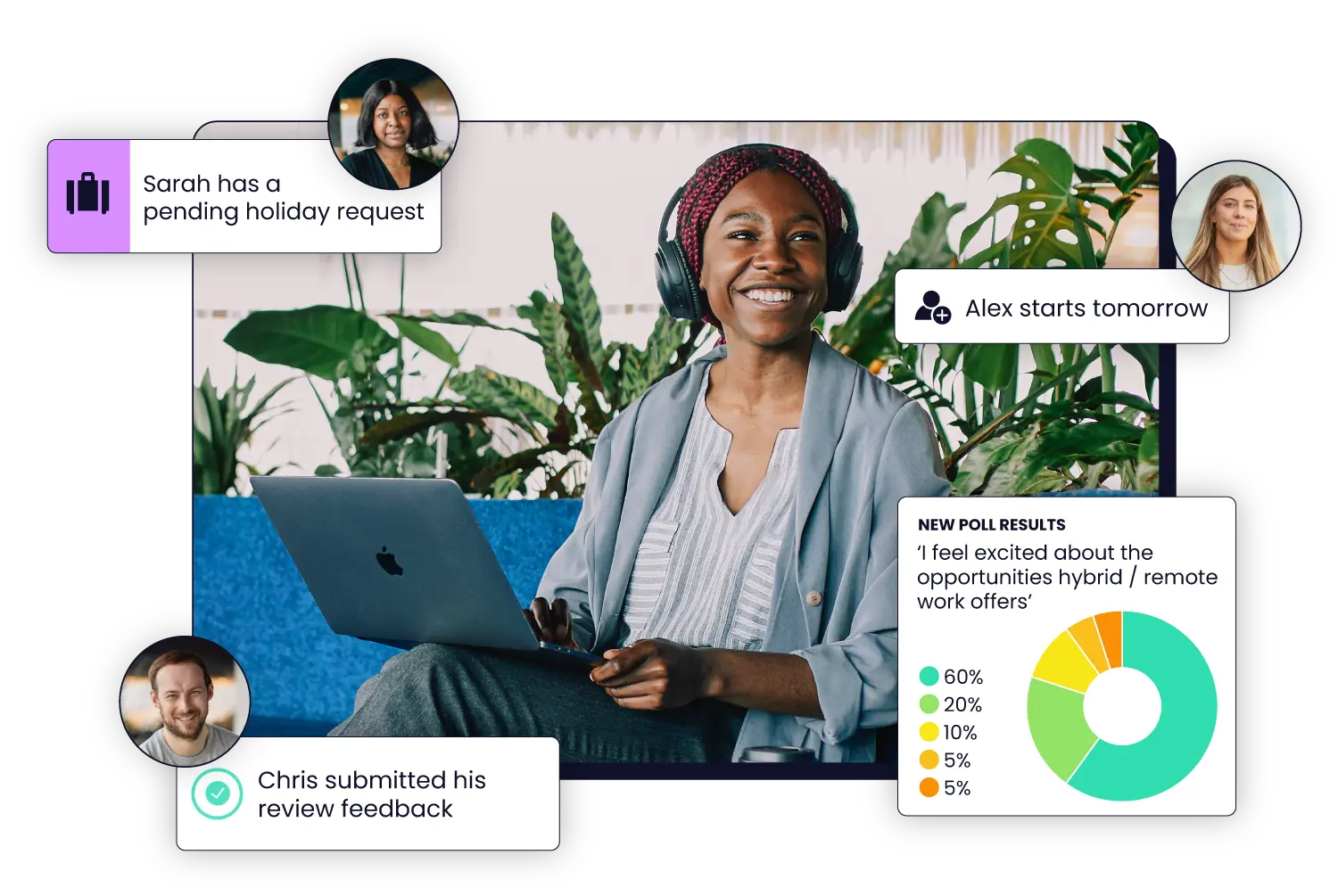

An HRIS (Human Resource Information System) centralises employee data, automates workflows, and helps businesses complete HR tasks more efficiently. HRIS software typically includes features like employee databases, time and attendance management, preparing data for payroll or benefits administration, and onboarding software.
Small businesses often use spreadsheets, docs, and email chains to store employee data and run HR operations, but these systems aren’t fit for purpose. An HRIS gives small businesses one place to store all employee data in a safe and compliant way, leading to time savings, fewer errors, and more complete audit trails.
An HRIS (Human Resource Information System) covers core HR features like data management, time-off management, and HR policies. An HRMS (Human Resource Management System) includes those key HRIS functions as well as others like performance management, recruiting, and payroll. Traditionally these terms described very different software platforms, but today many vendors use HRIS and HRMS interchangeably.
HRIS software costs vary depending on team size, requirements, and features, but typically small business HRIS systems cost anywhere from £2-5 per employee per month upwards. Check out HR software pricing in our guide.
UK small businesses are subject to compliance with right to work checks, UK GDPR, and HMRC reporting requirements, so it’s essential that your chosen HRIS has the right workflows and settings to enable you to record and manage data in line with regulations.
While you can use a spreadsheet to store HR data, it’s not recommended. Spreadsheets are open to human error, lack the right access controls, and aren’t fit for purpose. HRIS software is recommended for businesses, including very small teams. For more information, see our in-depth guide on spreadsheets vs. HR software.